
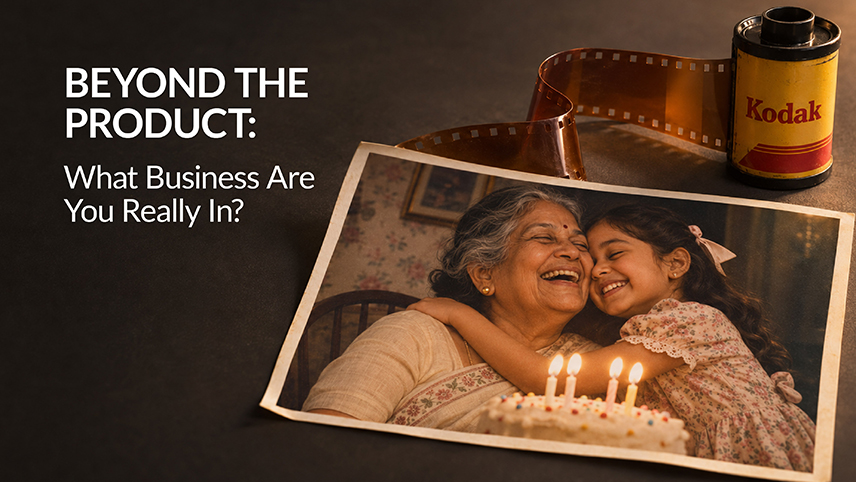
What Business Are You Really In? Ask Kodak.
Products Have Rationals. Brands Have Emotionals.
Key Takeaways:
- People buy emotionally, not logically: Most founders build as though the opposite were true.
- Kodak answered the question at product level: It said film. The real answer was memories, and the phone took the business.
- The question is about emotion, not category: What business are you really in means which feeling can you own.
- Founders spend their time on the product: Very little goes on the emotion the product is actually solving for.
- Rationals can be copied: Emotional ownership cannot, which is the whole reason brands exist.
There is a statement I keep coming back to.
Products have rationals. Brands have emotionals.
Many founders, owners and manufacturers believe people buy logically. More often than not, people purchase emotionally. So when I ask a founder what business are you really in, I am not asking about their category. I am asking which emotion they are trying to own.
Why did Kodak fail?
Think about Kodak and you probably think of cameras. Kodak did not. Kodak understood itself to be in the business of making film.
That was not a careless answer. It was a commercially sharp one. Film was the consumable, and consumables are where the money sits. It is the same logic as HP. You see a printer. What HP is really selling you is cartridges.
So Kodak kept improving film. Better film, then better film again.
And film has largely vanished, because the film is now in our phones.
Here is what makes it painful. Kodak had an extraordinary campaign called the Kodak Moment. Expand that idea by one step and you arrive somewhere else entirely. People do not take pictures because they want photographs. They take pictures to preserve memories.
Kodak was in the business of preserving memories. It answered film.
Which means you and I should have been carrying a Kodak phone, not an Apple or a Samsung. Kodak forgot to put a phone into their device. They got stuck at the product level, and why did kodak fail has a shorter answer than most case studies allow: they answered the wrong question correctly.
The same question, in a coffee shop
We recorded this episode at Cafe Anneyong in Pune, where every cup is poured by hand over three to five minutes.
You could say that business makes coffee. It does not. People do not sit there for the caffeine, which is available faster and cheaper almost anywhere. They are there for the personalisation and the experience of watching something made deliberately for them.
Starbucks answered the same question differently and built an empire on it. Not coffee. The third place. People have a home and an office and they need somewhere else that feels like theirs. Walk into one and you will find people working, friends meeting, interviews happening.
And Nescafe, which many of us in India grew up with, was never selling coffee either. Begin your day with Nescafe. They were selling a good morning. Mornings felt incomplete without it.
Same product category. Three completely different businesses.
Where founders actually spend their time
Most founders spend their energy on getting the product right and the manufacturing right. Very few invest the same energy in the question above.
When founders first come to us, the conversation usually opens the same way. Can you give us a brand name, a logo, a website, brochures. Can you handle our social media?
All of that is real work and all of it is execution. What gets skipped is the emotion underneath, and so you get a very well-made product in a category the founder keeps describing as highly competitive. It is competitive because everyone in it is competing on rationals.
Once you understand this properly, something shifts.
You are not selling a product. You are solving a problem, meeting an aspiration, or fulfilling a need.
Work out which of those three you are doing, and the emotion appears. The emotion gives you the brand. The brand gives you the Brand Flight Map, and the whole thing becomes buildable instead of guessable.
How to answer it for yourself
You do not need to hire a brand consultant in India to start this. You need an honest hour.
- Write down what you make. That is your product answer, and it is the one to discard.
- Ask what the customer is actually buying. Not the item. The outcome in their life.
- Ask why that outcome matters to them, and keep asking until the answer stops being about your product.
- Check whether a competitor could claim the same answer. If they could, go further.
At Seagull we run this as a structured process called Wings for Profit, but the thinking is not proprietary and founders can do the first pass themselves. What a good brand consultant in India actually adds is pattern recognition across many categories, not secret knowledge.
And once you have the answer, the next question is what to do with it. That is where the full sequence for how to launch a brand picks up.
Anyone can copy a rational. Your feature, your price, your specification, your delivery time. Give it eighteen months and somebody will.
Nobody can copy an emotion you have already occupied in a customer’s head.
Takeaway: find an emotionale, and work hard to own it. That is what creates your brand, and it is the only part of your business that cannot be reverse-engineered.
Watch the full episode of
Branding Over Coffee | Beyond the Product :
FAQs
- Why do customers say they want one thing and buy another?
It asks which emotion your brand owns, not which category it sells in. A jeweller is not in the business of gold and a developer is not in the business of square feet. The answer decides who you compete with and what you can charge. - Why did Kodak fail?
Kodak defined itself as a film company rather than a memory company. It kept improving film while the function moved into phones. The failure was not technological, it was a definition problem that made the right strategy invisible. - What is the difference between a product and a brand?
A product competes on rationals: features, price, specification, delivery. A brand competes on an emotion it has chosen to own. Rationals can be copied by any competitor. An occupied emotion cannot. - Can founders answer this without an agency?
Yes, and they should attempt it first. Write down what the customer is actually buying, ask why it matters until the answer stops being about your product, then check whether a competitor could claim the same thing. An agency adds pattern recognition, not secret knowledge.