
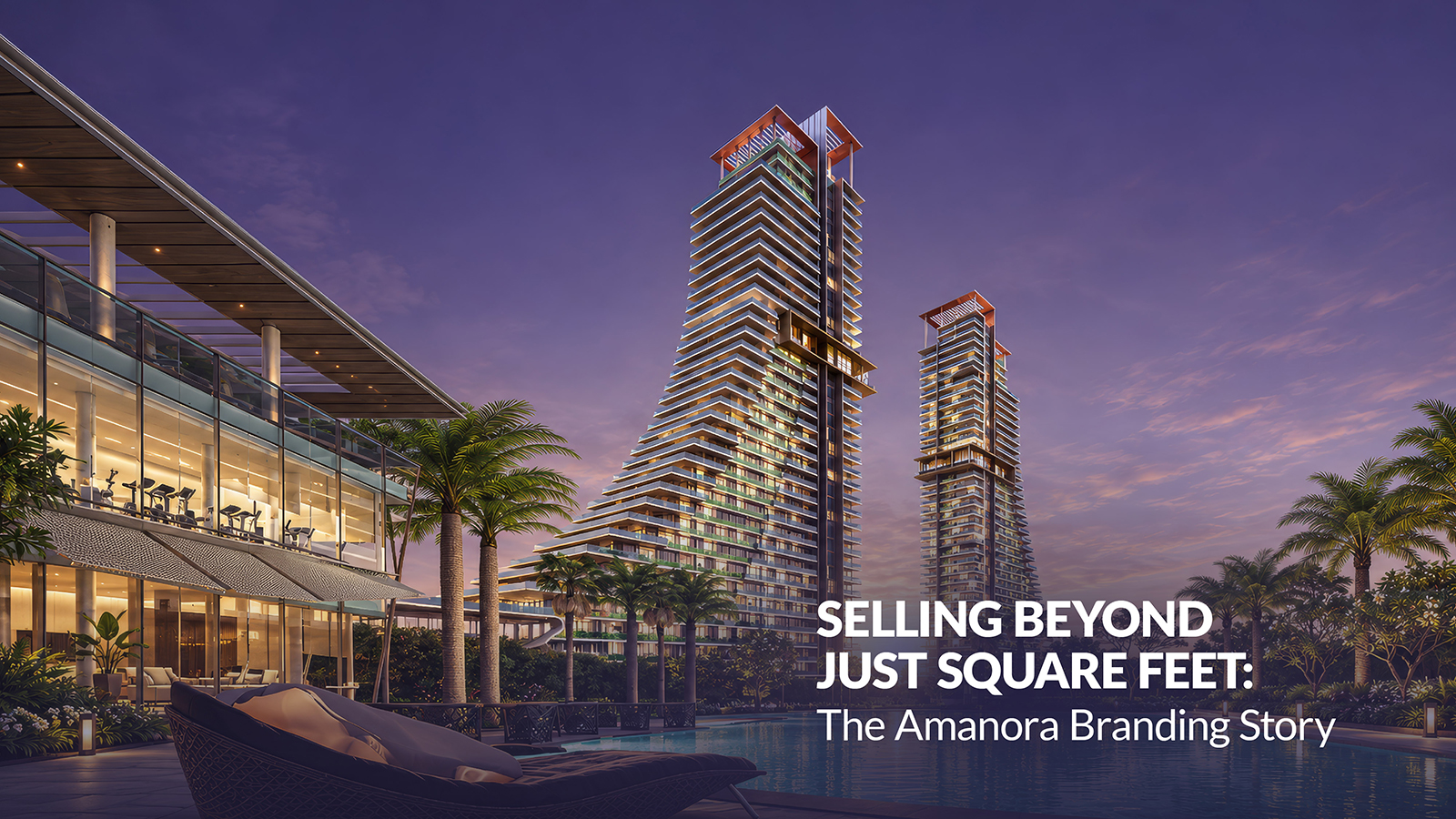
Real Estate Branding in India: Beyond Square Feet
Amanora Was Not Selling Square Feet.
Key Takeaways:
- Square feet is the product answer: Real estate branding india only begins once a developer stops there.
- Amanora sold the removal of urban chaos: Self-run schools, offices, water, power, roads, on a hundred acres.
- The concert was not sponsorship: 25,000 people were brought to the outskirts of Pune to experience the claim.
- Buyers hold several emotions at once: Chaos, privacy, health, risk, status. Pick the one you can deliver.
- Every emotion needs a reason to believe: Claim it without delivering it and word of mouth does the rest.
Ask most developers what they sell and you will hear a number. Square feet, at a rate, in a location.
That is the product-level answer, and in real estate it is the most expensive one available, because it puts you in a spreadsheet next to every other project in the same postcode.
What Amanora actually sold
Amanora launched as India’s first formal township under the township policy. More than a hundred acres of self-developed land, running its own schools, offices, gardens, shopping, water, electricity, sewage and roads.
Now, you could describe all of that as amenities. Many projects do, in a bullet list on a hoarding.
But stack those things up and ask what they add up to in a buyer’s life, and you get something else. Every one of them removes a daily negotiation with a city that does not work. The water tanker. The power cut. The school admission. The road nobody is responsible for.
Amanora was not selling square feet. It was selling the removal of urban chaos.
That is the shift that makes real estate branding india work. The product is unchanged. The business you are in is completely different.
Why a Bryan Adams concert
Here is the part people ask about most.
We organised a Bryan Adams concert at the township. Not as a sponsorship, and not as an advertisement with a celebrity in it.
The claim being made was that an international way of life was now available in Pune. You can say that on a billboard and nobody will believe you, because every developer says a version of it. What you cannot do on a billboard is let somebody stand inside the claim.
About 25,000 people travelled to the outskirts of Pune for that concert. They parked there. They walked the roads. They used the facilities. They saw what a self-run, professionally managed township city actually means, on an ordinary evening, with their own feet.
The concert was not the marketing. The visit was. The concert was simply the reason 25,000 people were willing to make it, and any honest brand launch case study in township branding will tell you that getting people physically inside the promise is worth more than any amount of describing it.
Buyers are running several emotions at once
Brands exist because of a multitude of emotions, and in real estate they run in parallel more than in almost any other category.
- Escape from urban chaos. The Amanora answer. Everything works and nobody has to chase it.
- Privacy. Fewer neighbours, controlled access, distance from the street.
- Health and longevity. Air, green cover, walkability, the ability to age in the same home.
- Removal of risk. Indian real estate has been notorious for delays and legal trouble, so a developer who simply delivers on time with clean paperwork is selling relief.
- Status. An address that signals the same thing a particular car in the driveway signals.
You cannot own all five. The work in real estate branding india is choosing the one you can actually deliver, and then building the entire project around proving it.
The part that is not optional
Every emotion you claim needs what we call a reason to believe.
Claim hassle-free living and then run out of water in April, and you have not failed at marketing. You have handed your buyers a story, and in a market driven by word of mouth they will tell it accurately and often.
This is why branding cannot sit at the end of a project as a communication exercise. The emotion has to be designed into the thing itself, which means it belongs in the conversation when the land is still being planned. Good township branding starts at the master plan, not at the launch, and it belongs inside a proper brand strategy process rather than a creative brief.
The sequencing that follows is the same for a township as for anything else, and it is set out in full in our guide to brand launch.
Final thoughts
A project that sells square feet competes on rate and gets compared on a spreadsheet.
A project that sells the removal of something a buyer hates about daily life gets compared with nothing, because nobody else is offering it in the same words. That is the whole lesson of this brand launch case study.
Takeaway: product-level selling is selling square feet. Decide what you are really selling, then go and build the proof.
Watch the full episode of Branding Over Coffee | Beyond the Product :
FAQs
- How do you brand a real estate project?
Start by identifying what the buyer is escaping or acquiring in their daily life rather than listing amenities. Choose one emotion the project can genuinely deliver, then design the product, the pricing and the experience around proving it rather than announcing it. - What do homebuyers actually buy?
Not space. They buy relief from something, or access to something. Freedom from urban chaos, privacy, health, certainty that the project will be delivered on time and legally clean, or the status an address confers. Most buyers hold several of these at once. - Why do developers use events to launch projects?
Because some claims cannot be made credibly in advertising. An event brings prospects physically into the project so they experience the promise rather than read it. The event is the reason people travel; the visit is the marketing. - What is a reason to believe in branding?
The evidence that makes an emotional claim credible. If a project promises hassle-free living, the reason to believe is the infrastructure that actually delivers it. Without one, the claim becomes a story customers tell against you.