
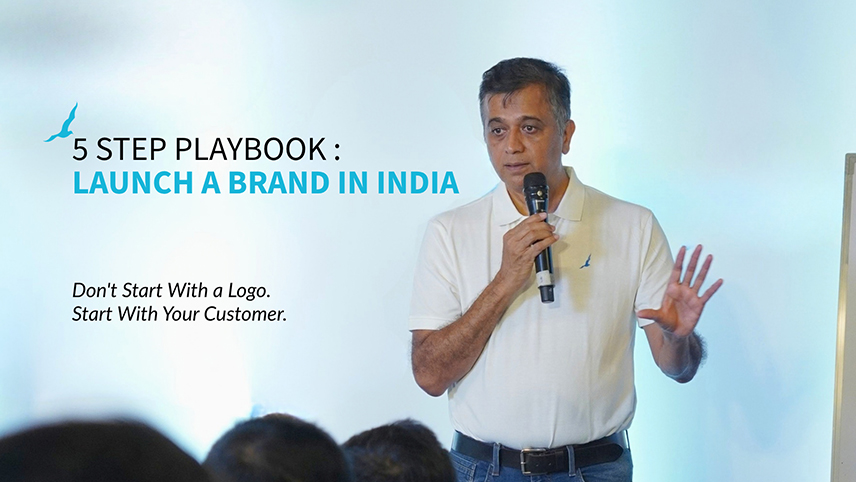
How to Launch a Brand in India: The Five Steps
Don't Start With a Logo. Start With Your Customer.
Key takeaways
Start with one real customer: Knowing how to launch a brand begins with one named person, not a demographic bracket.
- Move from what to why: Rational expectations get you considered. Emotional value is what makes you preferred.
- Own an Obvious Emotional Truth: Not a slogan you invented. A human truth that was already true before you arrived.
- Make the idea shareable: If your customer had to explain what is special about you, what would you want them to say?
- Then behave it: An idea is not a brand until the business behaves it, across all eight Ps and not only in the advertising.
Last Saturday, thanks to Manish Gupta & my fellow batchmates of Arha Samasti by Chrysalis, we conducted a Branding for Profit Workshop, for founders and entrepreneurs part of the Chrysalis Community.
I asked a room of founders a simple question. What business are you in?
Almost each founder thought and answered with their product/service.
That is where most businesses go wrong, and this happens long before anybody argues about a logo. Thirty years of being in the branding and advertising business has taught me this:
Branding is not your logo. It is not your advertising campaign.
And it is certainly not your social media feed.
Branding is about creating meaning and value in the mind of the customer, and then delivering it consistently. Which means how to launch a brand is a question about following the right order. Five steps. In sequence.
First, decide which game you are playing
Before the five steps, one honest look in the mirror. There are three ways to run a business.
The Level Player says I need to be as good as everybody else. Match the features, match the price, watch the competition, react. Look at any crowded automobile segment and you will see it. One vehicle creates the opportunity and six arrive competing on the same specifications until the differences disappear.
The Differentiator says I will be better than the others. Add something extra, improve the service, widen the gap. Better, certainly. But the competition is still setting your agenda, because you are still asking what they are doing and how to do it better.
The Value Creator asks a different question altogether. What value am I creating for my customer? That is where brands are built, and it is the only one of the three where the competition slowly becomes irrelevant.
1. Start with one customer
Not a target segment. One person, with a name, an age, a profession, a family, a city, and something happening in their life right now.
Write down what they rationally expect from your category. All of it. A business traveller landing in Mumbai for one night expects a clean room, a good bed, working Wi-Fi, hot water, fast check-in, and a fair price.
Then circle the three that matter most. Those are your non-negotiables. Miss them and the customer simply leaves.
2. Go from what to why
Take each of those three and keep asking why until you hit something human.
He wants fast check-in. Why? He does not want to waste time. Why? He has meetings. Why? He wants to stay in control. Why? Because when you are travelling for business, uncertainty and friction create stress.
That last answer is worth more than the first four. Rational expectations get you considered. Emotional value is what gets you preferred.
3. Find the Obvious Emotional Truth
Of all the emotions you uncovered, one matters most. We call it the Obvious Emotional Truth, or OET.
It is not a slogan. It is not a clever marketing statement.
It is a human truth that was already true before we knew it.
Obvious, because the moment you name it everybody recognises it. And once you have
it, ask the question that changes companies: what business are we really in?
Suppose the developers you supply believe there can be no errors in construction. Then an aluminium formwork manufacturer is not in the business of manufacturing formwork. It is in the business of ensuring zero errors in construction. That answer changes product development, technology, training, quality, service, design and communication. All of it.
4. Make the idea shareable
There is a gap between what your customer currently gets and what is actually possible. That gap is the opportunity, and competition is secondary to it.
Now turn the value into something people can carry. Turn it into ‘A Shareable Branding Idea’. It is a memorable expression of the value the organisation has committed to creating.
5. Then behave it
An idea is not a brand until the business behaves.
Advertising cannot compensate for poor behaviour. If you claim something, the organisation has to demonstrate it. That is what the Brand Flight Mapppppppp is for, and it runs across eight Ps: Product, Pricing, Packaging, Placement, Purchase Experience, Prosumer, Promotion and People.
Notice where Promotion sits. Seventh. We reach advertising only after the brand has been created, and that order is the whole lesson.
Ask the eight questions honestly. Is the product worth talking about? Is there a smarter way to price? Would people recognise us if the logo disappeared? Are we available differently? Is dealing with us easier than dealing with anyone else? Whose recommendation is more believable than our own advertisement? Is there something people anticipate from us? And after meeting our people, what exactly should the customer say about them?
Not that they were polite. Something closer to: they always solve my problem. They never make me chase them. I trust what they tell me.
Branding wisdom:
If the branding idea exists only in your advertising, you have run a campaign. When it exists across the business, you have a brand.
FAQs
- How long does it take to launch a brand in India?
Four to nine months for most businesses. Strategy takes eight to twelve weeks, identity another eight to ten, and go-to-market planning runs alongside the second half. Anything compressed below four months has usually skipped the strategy stage, which is the one that sets the ceiling.
- What is the first step in launching a brand?
Defining what business you are actually in, not what you sell. That single answer decides your competitor set, your pricing room and your message. Every other decision in a brand launch inherits from it, which is why it comes before naming or design. - Should I register the trademark before or after finalising the name?
Search before, file as soon as you have a shortlist. A trademark search in your relevant class costs very little and takes days. Finding a conflict after the packaging is printed is the most common expensive mistake in Indian brand launches. - What is the difference between a brand launch and a product launch?
A product launch introduces something to buy. A brand launch establishes what the company stands for, which then holds across every product that follows. You can launch many products under one brand, but you establish the brand once. - Can a small business launch a brand without an agency?
Yes, and the five steps above are the sequence to follow. What an agency adds is pattern recognition across many launches and the discipline to not skip the unglamorous early decisions. If you are doing it alone, that discipline is the part to guard.